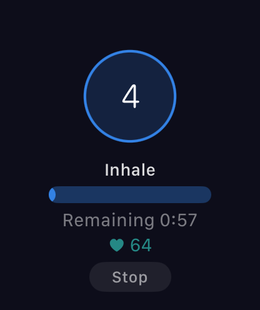
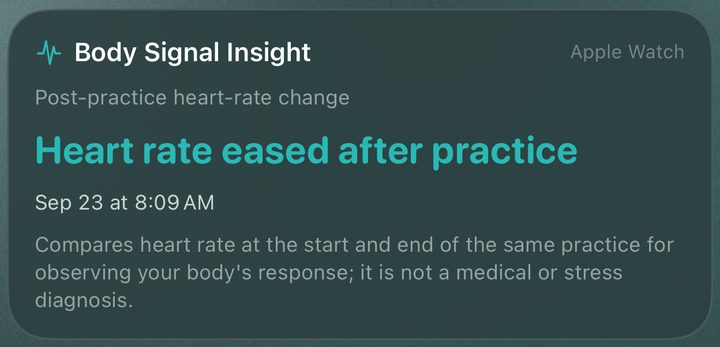
That minute may have slowed your heart a little.
This page can't measure that. The iKima app can: a 20-second fingertip reading on your iPhone camera, before and after you breathe, shows your heart rate and HRV.
The app is free to start and never asks you to sign up.
A racing heart or a tight chest is your body telling you something. A 20-second fingertip reading on the iPhone camera shows your heart rate and HRV before and after.
iPhone is enough · Built for Apple Watch · Core practice is free
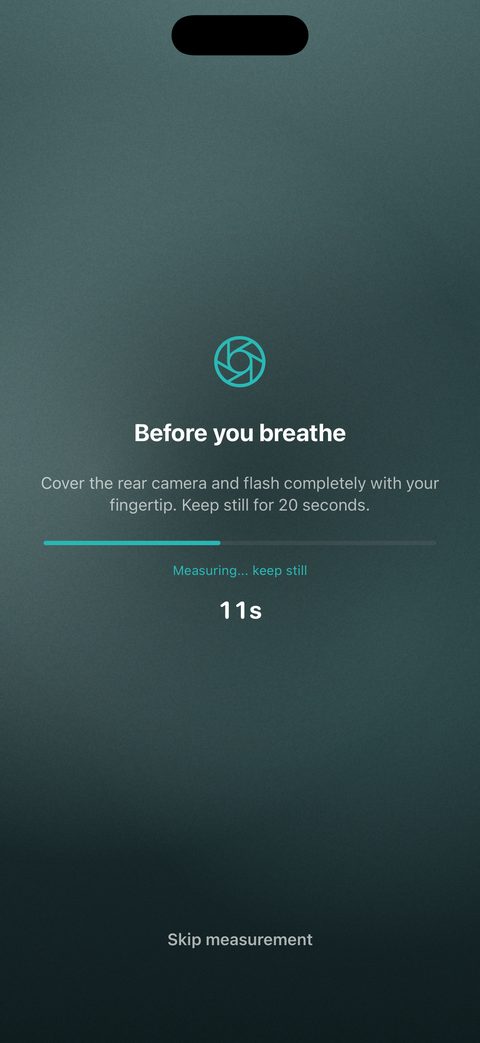
Most people start without an Apple Watch. The camera reading and the breathing guide on iPhone are the whole session, and you still see your numbers before and after.
Apple Watch is optional: it adds wrist haptics and live heart rate.
Rest a fingertip on the rear camera for about 20 seconds. The camera picks up the faint colour change each time your pulse pushes blood through the skin, and from that iKima works out your heart rate and HRV: how much the gap between beats varies. It all runs on the phone and no video is kept. The reading is for personal reference, not a medical measurement.
A light tap on your wrist marks each change of breath, so you can practise with your eyes closed. The Watch follows your heart rate through the session and shows the before-and-after change in your insights.
Philosophy
Your body registers stress long before you notice it. Heart rate creeps up, HRV drops, breathing goes shallow while you're still telling yourself you're fine. iKima's measurement turns that early signal into something you can see, so you act when the body first asks, not after it gives out.
Stress itself isn't a malfunction. It's a protective mechanism evolution left us. The modern problem isn't that stress exists; it's that the sympathetic system stays switched on and the body forgets how to return to parasympathetic repair mode.
Read your heart rate and HRV right now, from your fingertip or your wrist.
Rhythmic breathing with a longer exhale leans on the vagus nerve and helps your heart rate come down.
Return to baseline with the flexibility to meet whatever comes next.
When you're actually anxious, nobody remembers the steps. So iKima opens straight into breathing: no menus, nothing to memorise, no screen to stare at.
The maker of iKima · Why I built it →
See your heart rate live during every session. Compare before and after to measure the effect of your practice. Live on Apple Watch; on iPhone alone, a 20-second fingertip camera reading before and after.
Gentle taps mark each inhale, hold and exhale, so you don't need to look at the screen. On iPhone and Apple Watch.
All computation on-device. No account, no cloud sync, no biometric data leaving your device.
A 7-day chart, your streak and your most-used technique, so you can see how often you actually practise.
Log how you feel before and after each session to see your emotional patterns.
Fully localised in English, Japanese, Korean and Traditional Chinese.
Breathing is one of the few ways to change your heart rate on purpose. Your heart speeds up a little on each inhale and slows on each exhale, through the vagus nerve. Slow breathing with a longer exhale leans on that slowing side, which is why every technique in iKima is built around the exhale.
Heart rate variability (HRV) is a widely used marker of how flexibly your body responds to stress. A systematic review of slow-breathing studies found that slow breathing tends to raise HRV and goes along with feeling more relaxed, less anxious and less aroused.
References: Zaccaro et al. 2018 (Front. Hum. Neurosci.) · Balban et al. 2023 (Cell Reports Medicine)Read the long version: PPG, HRV and the extended exhale, with references →
Yes. Rest a fingertip on the iPhone's rear camera for about 20 seconds and iKima reads your heart rate and HRV from your pulse, using photoplethysmography (PPG). The full breathing guide works on iPhone alone.
iKima helps you notice tension in your body as it happens. After reading your physiological signal from the iPhone camera or Apple Watch, it guides extended-exhale rhythmic breathing that triggers the vagal reflex and engages the parasympathetic "brake", bringing you back to a stable baseline.
The autonomic nervous system's natural dynamic balance when it isn't chronically overloaded: the sympathetic branch responds quickly to a challenge, and the parasympathetic branch takes over repair once it's passed. iKima's breathing guidance is the switch that wakes up this self-reset.
iKima is the core product of Sentira Labs; sentiralabs.app is the team's and brand's official home. iKima's updates, science notes and privacy policy are all maintained by Sentira Labs.
No. iKima is a stress-awareness and breathing-practice tool. It does not diagnose, treat, or give medical advice; heart-rate and HRV readings are for personal reference only.